Review What Happens to a Supergiant That Would Make Its Life Come to an End - Supernova
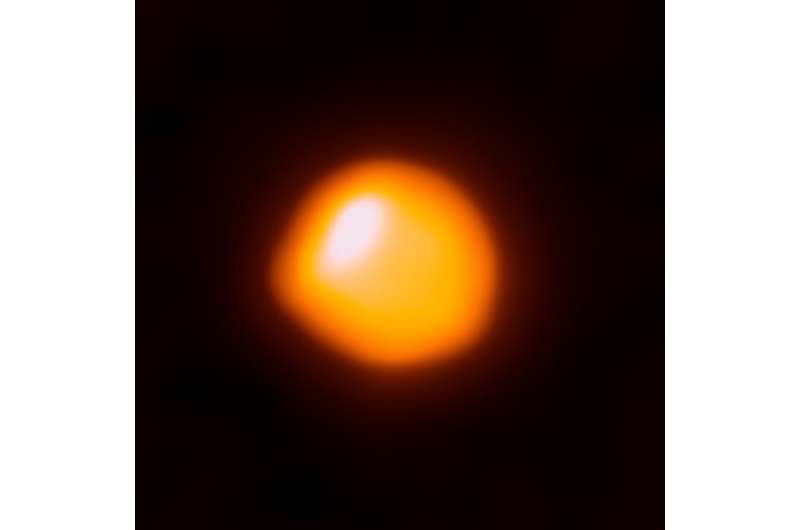
Betelgeuse has been the center of significant media attending lately. The red supergiant is nearing the end of its life, and when a star over 10 times the mass of the Dominicus dies, it goes out in spectacular fashion. With its brightness recently dipping to the lowest point in the last hundred years, many infinite enthusiasts are excited that Betelgeuse may shortly go supernova, exploding in a dazzling display that could be visible even in daylight.
While the famous star in Orion'due south shoulder volition likely meet its demise within the next million years—practically couple days in cosmic time—scientists maintain that its dimming is due to the star pulsating. The phenomenon is relatively mutual among cerise supergiants, and Betelgeuse has been known for decades to be in this group.
Coincidentally, researchers at UC Santa Barbara accept already made predictions about the brightness of the supernova that would result when a pulsating star like Betelgeuse explodes.
Physics graduate student Jared Goldberg has published a study with Lars Bildsten, manager of the campus's Kavli Plant for Theoretical Physics (KITP) and Gluck Professor of Physics, and KITP Senior Fellow Bill Paxton detailing how a star'south pulsation will affect the ensuing explosion when it does reach the end. The paper appears in the Astrophysical Periodical.
"We wanted to know what it looks like if a pulsating star explodes at unlike phases of pulsation," said Goldberg, a National Scientific discipline Foundation graduate research fellow. "Earlier models are simpler because they don't include the fourth dimension-dependent furnishings of pulsations."
When a star the size of Betelgeuse finally runs out of material to fuse in its center, it loses the outward force per unit area that kept it from collapsing under its own immense weight. The resultant core collapse happens in one-half a 2nd, far faster than information technology takes the star's surface and puffy outer layers to observe.
As the atomic number 26 core collapses the atoms disassociate into electrons and protons. These combine to grade neutrons, and in the process release high-free energy particles called neutrinos. Normally, neutrinos barely interact with other thing—100 trillion of them pass through your body every second without a single collision. That said, supernovae are among the most powerful phenomena in the universe. The numbers and energies of the neutrinos produced in the core plummet are so immense that even though but a tiny fraction collides with the stellar material, it's generally more than plenty to launch a shockwave capable of exploding the star.
That resulting explosion smacks into the star'south outer layers with stupefying energy, creating a burst that can briefly outshine an entire galaxy. The explosion remains brilliant for around 100 days, since the radiations tin escape only once ionized hydrogen recombines with lost electrons to become neutral once again. This proceeds from the outside in, meaning that astronomers encounter deeper into the supernova as time goes on until finally the light from the heart can escape. At that point, all that's left is the dim glow of radioactive fallout, which tin continue to smoothen for years.
A supernova'due south characteristics vary with the star'southward mass, total explosion energy and, importantly, its radius. This ways Betelgeuse's pulsation makes predicting how it volition explode rather more complicated.
The researchers institute that if the unabridged star is pulsating in unison—animate in and out, if y'all will—the supernova will behave as though Betelgeuse was a static star with a given radius. Nonetheless, different layers of the star can oscillate opposite each other: the outer layers aggrandize while the centre layers contract, and vice versa.
For the simple pulsation case, the team'due south model yielded like results to the models that didn't account for pulsation. "It just looks like a supernova from a bigger star or a smaller star at unlike points in the pulsation," Goldberg explained. "It's when you start considering pulsations that are more complicated, where at that place'south stuff moving in at the aforementioned fourth dimension equally stuff moving out—then our model actually does produce noticeable differences," he said.
In these cases, the researchers discovered that as light leaks out from progressively deeper layers of the explosion, the emissions would announced equally though they were the result of supernovae from different sized stars.
"Light from the office of the star that is compressed is fainter," Goldberg explained, "just as we would expect from a more meaty, non-pulsating star." Meanwhile, light from parts of the star that were expanding at the time would appear brighter, as though it came from a larger, not-pulsating star.
Goldberg plans to submit a report to Research Notes of the American Astronomical Order with Andy Howell, a professor of physics, and KITP postdoctoral researcher Evan Bauer summarizing the results of simulations they ran specifically on Betelgeuse. Goldberg is too working with KITP postdoc Benny Tsang to compare different radiative transfer techniques for supernovae, and with physics graduate student Daichi Hiramatsu on comparing theoretical explosion models to supernova observations.
More information: Jared A. Goldberg et al. A Massive Star'due south Dying Breaths: Pulsating Red Supergiants and Their Resulting Type IIP Supernovae, The Astrophysical Journal (2020). DOI: 10.3847/1538-4357/ab7205
Citation: Physicists model the supernovae that result from pulsating supergiants similar Betelgeuse (2020, February 28) retrieved xviii April 2022 from https://phys.org/news/2020-02-physicists-supernovae-event-pulsating-supergiants.html
This document is subject to copyright. Apart from any fair dealing for the purpose of private study or research, no part may exist reproduced without the written permission. The content is provided for data purposes only.
Source: https://phys.org/news/2020-02-physicists-supernovae-result-pulsating-supergiants.html
0 Response to "Review What Happens to a Supergiant That Would Make Its Life Come to an End - Supernova"
Post a Comment